
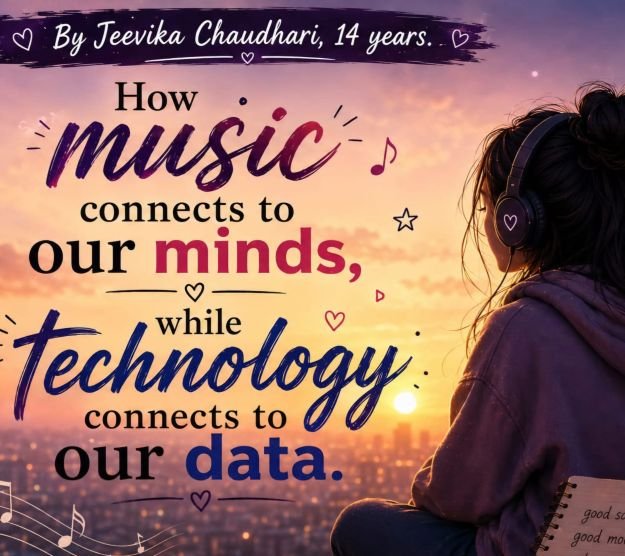
Do you listen to songs?
Most of us do. Some may enjoy the evergreen voices of Kishore Kumar and Lata Mangeshkar. Some may love Sonu Nigam and Alka Yagnik, while many today can’t imagine a playlist without Arijit Singh, Shreya Ghoshal, Taylor Swift or Justin Bieber.
People often say, “Songs bring back memories.” For the longest time, I never believed it.
I wasn’t really a fan of music until I was around eleven years old. I would listen to songs occasionally, but I never paid much attention to the lyrics or emotions behind them. As I slowly started exploring music, I found myself listening to Arijit Singh and Shreya Ghoshal quite often.
Then one day, while listening to a song, something felt different. It wasn’t just another melody playing in my ears. I could actually feel the emotions behind it. The lyrics reminded me of certain moments in my life. For the first time, I realised that songs don’t just entertain us—they connect with us.
That was when I understood why people say that songs bring back memories.
There is actually a simple psychological reason behind this.
Our brain naturally creates associations. Whenever we hear something emotional, it automatically tries to connect it with our own experiences. Suppose someone tells you about losing a loved one. Even if you were perfectly fine a moment ago, you might suddenly remember someone you lost and begin to feel emotional too.
Music works in exactly the same way.
A song can remind us of childhood, school memories, old friendships, family vacations or even moments we wish we could relive. Sometimes it reminds us of people we have moved on from. Sometimes it reminds us of the happiest version of ourselves.
But songs don’t only connect us with our past.
They also connect us with our future.
Have you ever listened to a motivational song before an exam, a competition or a sports match and suddenly felt unstoppable? Have you ever heard a romantic song and imagined your future partner? Have you ever listened to an inspiring song and thought, “One day, I want my life to feel like this.”
Our brain doesn’t always differentiate between memories and imagination. If something feels meaningful enough, we emotionally connect with it. That is why some songs become our comfort songs even before the situations they describe actually happen.
Now here’s something even more interesting.
Have you ever wondered why your music app always seems to know exactly what you want to hear next?
Many people think our phones secretly listen to every conversation. While that idea sounds mysterious, recommendation systems mostly work in a different way.
Every time we search for a song, save it to our playlist, replay it, skip another song, or spend extra time listening to a particular genre, the app collects those signals. It studies our preferences and recommends similar songs.
This process is called a Recommendation Algorithm.
The same thing happens on YouTube, Instagram, Pinterest, Facebook and many other platforms. The more we interact with certain content, the more similar content appears on our feed.
Watch a few travel videos, and your homepage starts filling with travel vlogs.
Like motivational reels, and suddenly your entire feed becomes inspirational.
Listen to emotional songs, and your playlist starts suggesting songs with similar moods.
Sometimes it almost feels like our devices understand us better than people do.
And honestly, that’s both amazing and a little scary.
These recommendations are designed to keep us engaged. We tell ourselves we’ll listen to just one song, but it turns into ten. We open Instagram for five minutes and somehow spend an hour scrolling.
The apps don’t force us to stay—they simply become very good at predicting what will keep us interested.
Another thing many of us don’t think about is privacy.
Almost every app says it is free and safe to use. While they do provide security features, they also collect information about how we use their services. They know what we search for, what we watch, what we like, what we save and what we spend time looking at. This information helps personalise our experience and also helps show advertisements that are more relevant to us.
This is where the idea of a digital footprint comes in.
Just as our feet leave footprints on sand after we walk, every action we perform online leaves tiny traces behind. Every search, every comment, every like, every playlist and every reel contributes to our digital footprint.
Individually, these actions may seem small.
Together, they create a picture of who we are—our interests, hobbies, habits and preferences.
I still remember something my mentor once said:
“When something is free, you are the product.”
At first, I didn’t understand what that meant.
Now I do.
Most free platforms don’t charge us money because our attention has value. The more time we spend using them, the more information they collect to improve recommendations and advertisements.
But does that mean we should stop listening to music?
Absolutely not.
Music is one of the most beautiful forms of expression. It comforts us when we are lonely, motivates us when we are tired, celebrates our happiest moments and silently sits beside us during our saddest ones. It helps us understand emotions that words alone sometimes cannot explain.
Technology has made discovering music easier than ever before. Thanks to recommendation systems, we often find songs that become lifelong favourites.
However, just as we choose the songs that influence our emotions, we should also be aware of the technology that influences our attention.
So the next time a song suddenly reminds you of a forgotten memory, smile—because your heart remembered something beautiful.
And the next time your playlist recommends the perfect song, remember that while music understands your emotions…
the internet understands your habits.
Both know a little about you.
The difference is that one heals your heart, while the other learns from your clicks.
In today’s world, where every click is tracked and every second of our attention is valuable, awareness is our greatest strength. Use technology wisely, protect your privacy, and never let algorithms decide your identity.
Let music inspire your emotions, but let your decisions be guided by your own values and experiences.
Because at the end of the day, the best playlist is not the one your app creates for you—it is the one your life writes through its memories.
The next time you put on your earphones, enjoy the music—but don’t forget the world outside them.
Create memories instead of only consuming content.
Dance with your friends, sing with your family, travel, laugh, fail, succeed and truly live.
Because one day, your favourite song won’t remind you of a reel you watched—it will remind you of a life you actually lived.
Jeevika Chaudhari, 14 years.
Blogs
Copyright © 2026. All Rights Reserved.